
Your cat rubs against your legs every evening at the same time. Your dog rests its head on your knees as soon as you sit down. These proximity rituals reflect a need for contact and comfort that you can extend through simple gestures. Cocooning care for pets is not a whim: it contributes to a physical and emotional balance recognized by animal welfare professionals.
Massage and Touch: What Your Pet’s Skin Really Perceives
The skin of dogs and cats does not react like ours. Their epidermis is thinner and more sensitive to pressure variations. An appropriate massage activates local blood circulation and promotes muscle relaxation, but only if a few basic rules are followed.
The principle is to proceed gradually. Start by placing your palm flat on the animal’s side for a few seconds, without moving. If your companion remains calm, make slow circular movements with your fingertips, avoiding direct contact with the spine.
In cats, the area behind the ears and under the chin often triggers an almost immediate purring. In dogs, the shoulders and the base of the neck are areas where tension accumulates, especially after a long walk.
To explore this type of approach further, the care offered by La Fibre Câline details gentle techniques suitable for both dogs and cats. Always associate massage with a calm moment, never after excitement or a meal. Three to five minutes is sufficient at first. The idea is for the animal to associate this contact with a pleasant experience, not a constraint.
Relaxing Grooming for Dogs and Cats: An Underestimated Cocooning Care
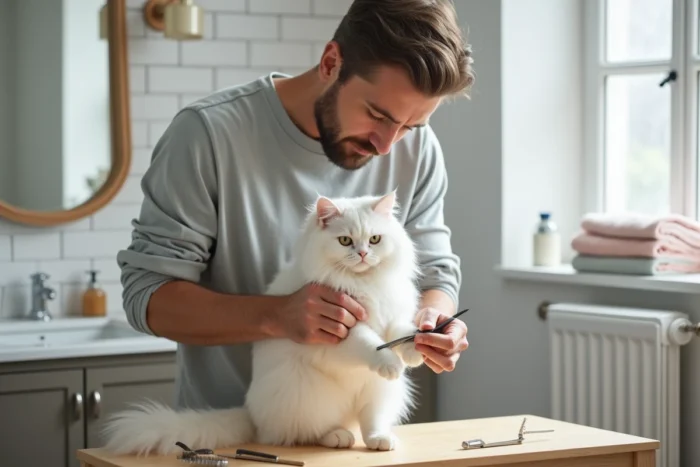
Have you ever noticed that some dogs close their eyes during grooming? It’s no coincidence. Slow grooming, done with a soft brush, stimulates the nerve endings in the skin and produces a soothing effect comparable to a prolonged caress.
The difference with regular grooming lies in the intention and rhythm. Maintenance grooming aims to detangle, remove dead hair, and prevent knots. Cocooning grooming aims for the relaxation of the animal, not the performance of the coat. Specifically:
- Choose a brush with round, soft bristles, suitable for your companion’s hair length, to avoid any skin irritation.
- Brush in the direction of the hair with slow, steady motions, taking breaks every thirty seconds to let the animal breathe.
- If your cat or dog shows signs of discomfort (flattened ears, low tail, growling), stop immediately and try again another day.
Consistency matters more than duration. Two minutes every evening create a ritual that the animal looks forward to. Grooming then becomes a bonding moment, not just a hygiene task.
Thermal Comfort and a Soothing Environment in Daily Life
Cocooning care does not only involve direct contact. The environment in which your pet lives plays a significant role in its stress level. One often overlooked point is heat management during heatwaves.
During high temperatures, a cooling mat placed in the coolest room of the house provides immediate refuge. A damp towel rubbed on the dog’s pads and belly complements this setup. For cats, who regulate their temperature less effectively through breathing, a source of cool water available at all times and a shaded area are often sufficient to prevent discomfort.
Beyond temperature, the sound environment matters. A dog exposed to loud and unpredictable noises (construction, storms, fireworks) accumulates stress that manifests as panting, trembling, or fleeing behavior. Creating a calm space, with a cozy bed and soft lighting, allows the animal to refocus.
The Gradual Familiarization Protocol
All cocooning care shares a common prerequisite: the animal must accept contact before deriving pleasure from it. This is what behaviorists call gradual familiarization, a principle derived from positive education.
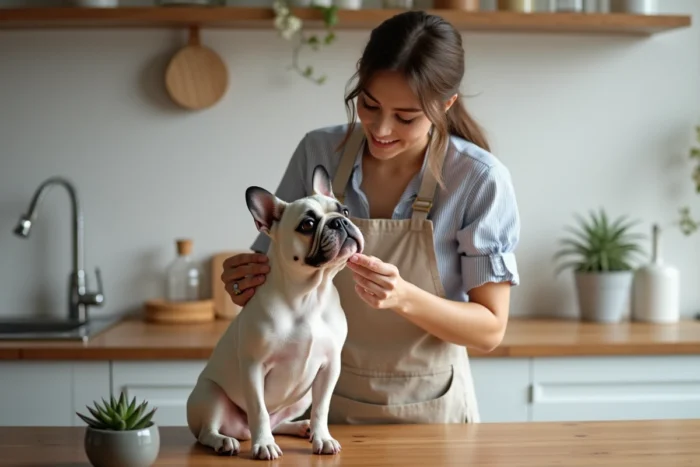
The mechanism is simple. You present the care object (brush, towel, mat) to your companion without using it. Let them sniff it and approach it at their own pace. Reward each calm interaction with a treat or a stroke. Then, during the next session, introduce contact for just a few seconds, always associated with a reward.
This method works for grooming, ear cleaning, applying balm to pads, or putting on a coat in winter. A care imposed abruptly becomes a source of stress, even if it starts from good intentions. Better three weeks of gentle progression than a forced session that creates lasting rejection.
Daily Animal Welfare: Recognizing Signs of Relaxation
You provide cocooning care, but how do you know if it’s working? Observation remains the best tool.
- In dogs, slow breathing, half-closed eyelids, and a relaxed body lying on their side indicate an advanced state of relaxation.
- In cats, purring combined with kneading with their front paws signals real emotional comfort.
- Conversely, an animal that repeatedly licks its lips, turns its head away, or stiffens during care sends you a clear signal: this is not the right time.
The French Veterinary Academy, in its White Paper on Pet Welfare published in 2019, defines welfare as a “positive mental and physical state related to the satisfaction of the animal’s physiological and behavioral needs, as well as its expectations.” Cocooning care directly fits into this definition: it meets the need for contact, security, and sensory comfort.
Adapting your gestures to your companion’s reactions, respecting their pace, varying the care according to the season and emotional state of the moment: this is what distinguishes an effective cocooning routine from a mere sequence of mechanical gestures. The best indicator remains the same: an animal that comes back to you on its own to ask for more.