Talking about the “best fabric in the world” without specifying the criteria is like comparing oranges and jet engines. The debate constantly intertwines three distinct realities: the quality of a raw fiber (length, fineness, strength), the expertise in processing (spinning, weaving, finishing), and a country’s industrial weight in the global market. In 2024, online rankings often reflect only one of these axes, which muddles the understanding for anyone looking to source fabric.
Raw fiber versus finished fabric: a confusion that skews textile rankings
Most articles positioned on the query “best fabric in the world” actually answer a different question: what is the best natural fiber. Egyptian cotton, with its extra-long fibers, consistently ranks at the top. Its softness, strength, and ability to produce very fine threads make it a benchmark for high-end home textiles and certain shirt-making.
An exceptional fiber does not guarantee an exceptional fabric. Poorly spun or woven Egyptian cotton on a low-quality loom will yield mediocre results. Conversely, well-processed Turkish or Indian cotton can surpass a fabric labeled “Egyptian cotton” whose traceability remains unclear.
Several market players have indeed been flagged for misleading labeling regarding the true origin of their cotton. To identify the nations that truly stand out, the ranking of the best fabrics in the world precisely cross-references these different criteria.
The distinction between raw material-producing countries and processing countries remains the blind spot of most rankings. Egypt produces remarkable fiber, but the majority of its exports leave in raw form to spinning mills located elsewhere.
Italy, Japan, Portugal: countries where weaving creates value
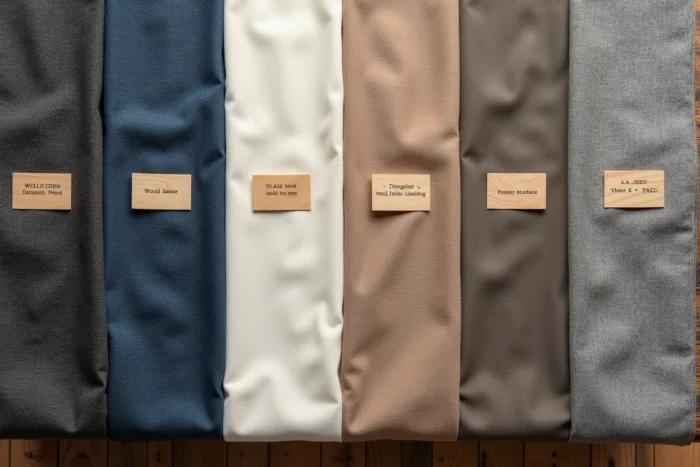
Shifting the question towards finished fabric (the one touched by a stylist or tailor) radically changes the landscape. Italy has dominated the high-end fabric segment for decades, thanks to an ecosystem concentrated around Biella for wool, Como for silk, and Prato for blends.
The Italian expertise does not rely on a local fiber, but on a mastery of spinning, dyeing, and finishing that is difficult to replicate.
Japan occupies a unique place in denim and technical fabrics. The workshops in Kojima and Ibara produce selvedge fabrics known for their consistency and durability, recognized by high-end denim brands worldwide. Weaving on old shuttle looms, which is slower, provides a characteristic edge and texture that modern industrial looms do not replicate.
Portugal, on the other hand, is gaining strength as a credible European alternative. Its strength lies in the combination of modern industrial fabric, lower labor costs than Italy, and logistical proximity to French and German markets. Several European brands have relocated their production there in recent years.
What these three countries have in common
- A processing expertise that does not depend on a local fiber but on an integrated value chain (spinning, weaving, finishing in the same territory)
- A strong sector specialization: wool and silk for Italy, denim and technical fabrics for Japan, knit and jersey for Portugal
- Stricter quality and traceability standards than in major volume-producing countries, which reassures brands positioned in the mid and high-end markets
Turkey and India: does industrial weight change the game for textile quality?
Turkey has established itself as a textile hub close to Europe. Relocalization trends and shorter supply chains have accelerated this movement in recent years. The country produces cotton on its own soil, processes it locally, and exports finished fabrics, giving it a rare advantage of vertical integration.
However, the perception of Turkish quality remains uneven. In the home textiles segment, Turkey competes with Egypt in terms of softness and density. In the high-end apparel fabrics, field feedback varies: some Turkish factories achieve a level comparable to Portugal, while others remain focused on volume and fast fashion.
India presents a similar profile but on a different scale. As the world’s largest cotton producer, the country has colossal industrial capacity. Indian quality varies greatly by region and factory, ranging from high-end artisanal fabrics (khadi, Varanasi silks) to low-end cotton intended for mass export. Evaluating “India” as a homogeneous block makes no textile sense.
Carbon footprint and European regulations: the new criteria for textile ranking
The debate on the best fabrics is no longer limited to material and expertise. In 2024, sustainability of production enters the evaluation of textile countries. Recent European regulations on origin labeling, eco-contribution, and combating fast fashion are changing the comparison criteria.
An Italian or Portuguese fabric produced with a European energy mix and subject to strict environmental standards does not have the same impact as a fabric made in a country where coal dominates electricity production. This dimension, absent from traditional rankings, increasingly weighs in brands’ purchasing decisions.
- Mandatory environmental labeling, currently being rolled out in Europe, will force brands to document the origin and impact of each fabric used
- Proposals for taxing ultra-fast fashion directly target countries whose model relies on low-cost volume
- Certifications (GOTS, Oeko-Tex, BCI) are becoming prerequisites for access to European markets, benefiting countries already engaged in these processes
The notion of “best fabric” is thus shifting from a purely tactile criterion to a composite one. A country may produce a beautiful fiber and lose points on traceability or carbon footprint. The available data does not yet allow for a unique ranking that incorporates all these parameters, but the direction is clear: the textile quality of tomorrow will be measured as much in grams of CO2 as in fiber length.