
The fishing license for 2026 has been on sale since December 2025, and the prices displayed on cartedepeche.fr provide a first idea of the budget to be expected. The inter-federal license remains set at 114 euros, the adult departmental license around 87 to 90 euros depending on the federations, the minor license at 27 euros, and the discovery license for those under 12 at 8 euros. These amounts only tell part of the story.
Total cost of access to fishing in 2026: what the license fee doesn’t reveal
The price printed on the fishing license covers three elements: the membership fee to an AAPPMA, the aquatic environment fee paid to the water agencies, and, for the inter-federal license, the EHGO, CHI, and URNE reciprocity stamps. This price does not include any local surcharges, restrictions on non-reciprocal routes, or specific opening periods for each department.
For an occasional angler or a senior on a tight budget, the question of “total access cost” deserves to be asked differently. The daily license, priced around 14 euros in several departments, or the weekly license at 36.50 euros, may seem advantageous. However, they do not provide access to the same routes or the same number of lines as an annual license.
A point often overlooked: holding a fishing license is not enough. Article L.436-1 of the Environmental Code requires compliance with the membership fee and the aquatic environment fee, but also having the authorization from the holder of the fishing rights on the targeted lot. Some municipal or state-owned water bodies impose their own restrictions on location, period, or number of rods. You can find the updates on Sportetica for an updated overview of these conditions.
Senior fishing license in 2026: is there a reduced rate?
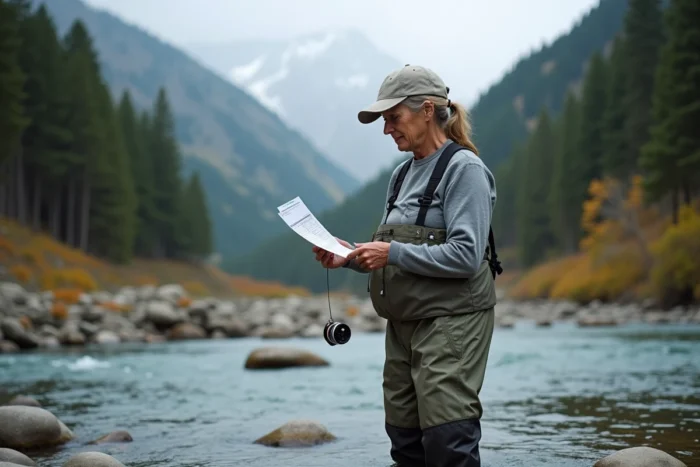
The National Federation of Fishing in France does not offer a specific rate labeled “senior” for the 2026 fishing license. Unlike other leisure activities (transport, museums, municipal pools), no national discount is linked to age for those over 60 or 65 years old. A retiree pays the same price as a 30-year-old for the same annual license.
This observation prompts a search for other avenues of reduction. Some local AAPPMA offer promotional gestures or tailored packages, but these initiatives remain at the discretion of each association. It is necessary to inquire directly with the departmental federation of one’s place of residence.
For senior profiles who fish infrequently (a few outings per year, in a single department), the daily or weekly license may represent a better cost-to-usage ratio. A simple calculation can clarify:
- Fewer than three outings per year: the daily license (about 14 euros per outing) is more economical than a departmental annual license.
- Between four and six outings concentrated over one or two weeks: the weekly license at 36.50 euros covers the period without committing to the budget of an annual license.
- Regular fishing throughout the year in a single department: the adult departmental license (87 to 90 euros) is the logical choice.
- Fishing in several reciprocal departments: the inter-federal license at 114 euros becomes cost-effective from the second outing outside the department.
Pass’Région and local aids: reductions that exist but not for everyone
In Auvergne-Rhône-Alpes, the Pass’Région scheme allows for a refund of up to 30 euros on an annual fishing license, but it exclusively targets 15-25 year-olds. This scheme is subject to conditions regarding the purchase period and the submission of a file to the Region. Seniors are not eligible.
The available data do not allow for a comprehensive inventory of comparable aids in other regions. Some local authorities occasionally fund introductory actions or free discovery days, but these schemes do not reduce the price of the license itself. Feedback from the field varies on this point: several departmental federations indicate they receive no regional aid directed towards fishing licenses, while others benefit from undocumented local partnerships online.
For an angler looking to reduce their total cost, the most reliable approach remains to contact their departmental federation and local AAPPMA directly to check for the existence of aids or negotiated rates.
Catfish regulation 2026: a hidden cost for some anglers

The recent classification of the catfish as a species likely to cause biological imbalances (ESDB) in certain basins modifies the obligations of the concerned anglers. The decree cited by several federations does not apply to the entire French territory, but only to specific basins, such as the Loire-Bretagne basin.
In the affected areas, capturing a catfish entails declaration obligations and, in some cases, a prohibition on releasing it back into the water. These constraints do not change the price of the license, but they alter the practical fishing conditions and may make certain routes less attractive for anglers targeting other species.
The geographical scope of the ESDB classification is information to verify with each departmental federation before choosing a fishing location and the most suitable type of license. An angler passing through who buys a daily license for a weekend on the Loire does not have the same obligations as a holder of an annual license in Saône-et-Loire.
Fishing license 2026: what to check before purchasing
Before confirming the purchase online or at a retailer, a few points deserve systematic verification:
- The reciprocity of the target department: not all departments are covered by the EHGO, CHI, and URNE agreements. Some lots remain non-reciprocal, even with an inter-federal license.
- The local rules of the chosen AAPPMA: number of rods allowed, regulated species, specific opening periods in the first category (predominantly salmonid) and in the second category.
- The existence of a promotional license: the women’s discovery license, offered at 42 euros in several departments, provides access to one line in the first and second categories with EHGO, CHI, and URNE reciprocity.
The amount displayed on the license remains a partial indicator. The true cost of a fishing season is calculated by cross-referencing the price, the number of planned outings, the desired geographical scope, and local regulatory constraints. For a senior or an occasional angler, taking ten minutes to compare the available options in their department can save several tens of euros over the year.