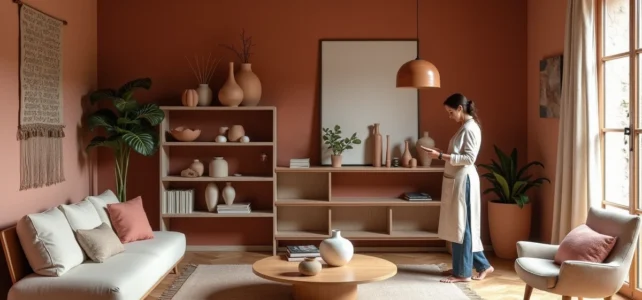
Interior decoration has changed its tune. Warm natural palettes, ceilings treated as full-fledged surfaces, and sculptural furniture are redefining what it means to transform a home. Here are ten concrete decor ideas, chosen for their real impact on layout, far from generic lists of cushions and candles.
1. Colorful flat ceiling to restructure a room
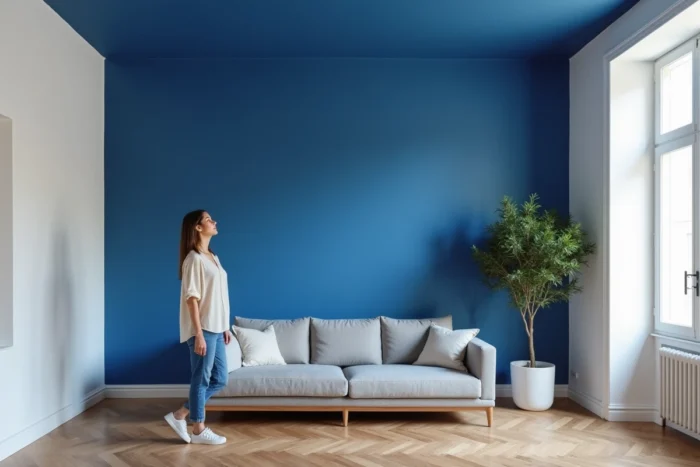
The ceiling remains the most neglected surface in decoration. Applying a flat color (terracotta, deep green, chocolate brown) changes the perception of volumes without touching the furniture. In a living room with standard ceiling height, a strong hue visually lowers the space and creates a feeling of enclosure.
We recommend extending the color onto the first ten to fifteen centimeters of the wall to avoid a too abrupt break. This technique, sometimes called “drop,” unifies the treatment and gives a more polished result than a simple isolated flat color.
Browsing the decor ideas from maisonfjord fr, you can find this volumetric approach applied to different room configurations.
2. Graphic floor with geometric patterns in the kitchen
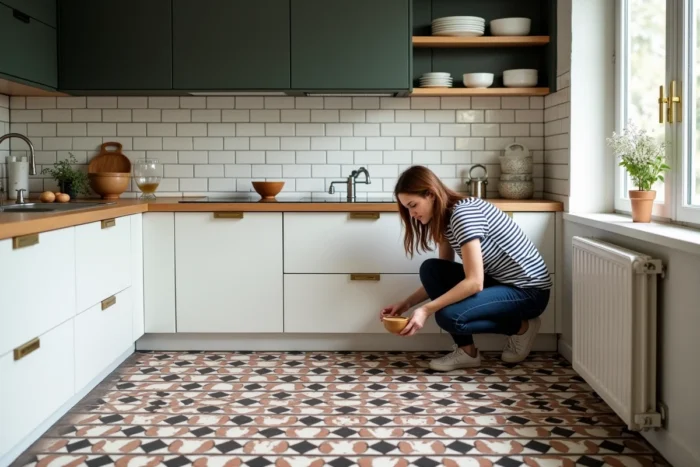
Graphic floors constitute the second “decor zone” that most layouts overlook. In the kitchen, a geometric patterned cement tile or structured vinyl provides a strong visual identity without cluttering the countertops.
The graphic floor replaces a rug and structures the floor space. It delineates the kitchen area in an open plan better than an island alone. Be careful with the choice of format: a pattern that is too small in a large room creates a visual noise effect. We see better results with medium-sized tiles.
3. Sculptural furniture as the focal point of the living room
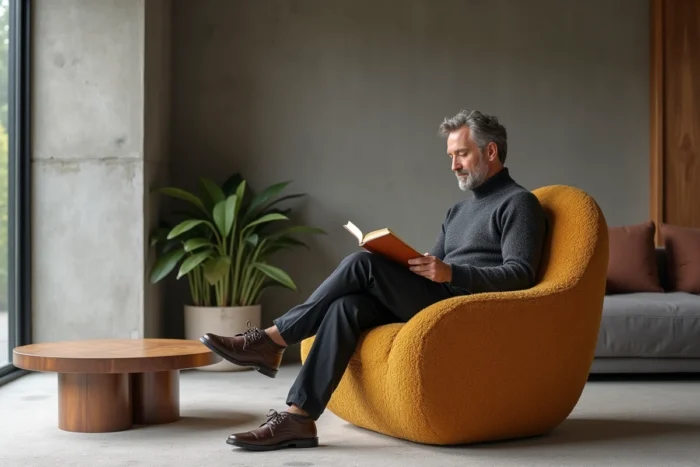
The 2026 trend treats furniture as an almost artistic piece. An organic-shaped sideboard, a console with asymmetrical legs, or a monolithic coffee table becomes the focal point of a living room, much more than a wall painting.
This shift in logic requires reducing the number of furniture pieces to highlight each item. A living room with a simple sofa, a sculptural piece, and a light fixture is sufficient. Any addition dilutes the effect.
4. Local craftsmanship in pottery and weaving to break away from mass production
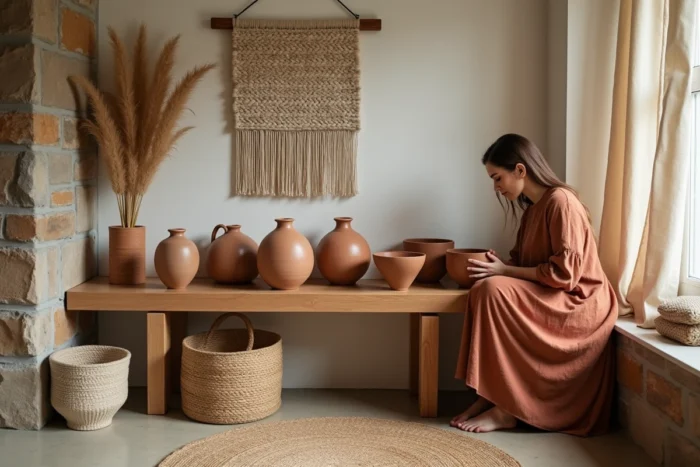
Local craftsmanship (pottery, weaving, custom furniture) emerges as a lever of authenticity in an interior. A handmade ceramic on a shelf does not produce the same effect as a mass-produced object, even at a comparable price.
The “handmade” works particularly well in high-traffic areas (entryway, living room) where it catches the eye. We recommend grouping artisanal pieces in pairs or threes rather than scattering them throughout the house.
5. Terracotta and ochre palette for a living room with enveloping neutrals
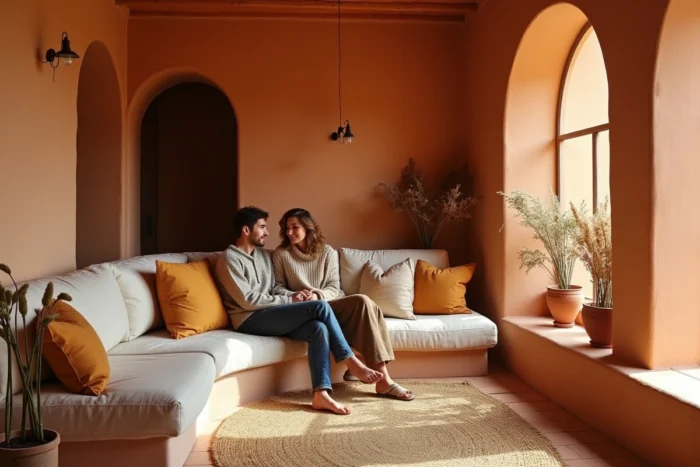
The trendy colors of 2026 favor lasting warmth. Terracotta, chocolate brown, ochre, and olive compose a palette that ages well and does not depend on seasonal fashion.
A common mistake is to use these shades only in accessories (cushions, throws). For real impact, we recommend applying them to at least one large surface (a wall, a sofa, a rug). The rest of the room can remain in natural whites or enveloping neutrals for balance.
6. Contemporary moldings to add texture to walls
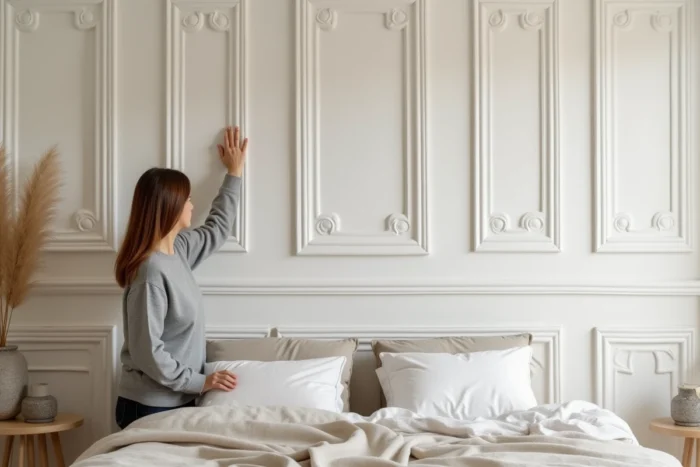
Moldings are no longer reserved for Haussmannian interiors. Installed on a wall and painted tone-on-tone, they create a subtle relief that enriches an interior without adding furniture or wall decoration.
The choice of profile changes everything. A thin, straight profile suits modern interiors. A wider, rounded profile leans towards a revisited classic style. Installation should be done on an accent wall, ideally one that receives side light to reveal the relief.
7. Statement light fixture hanging above the dining table
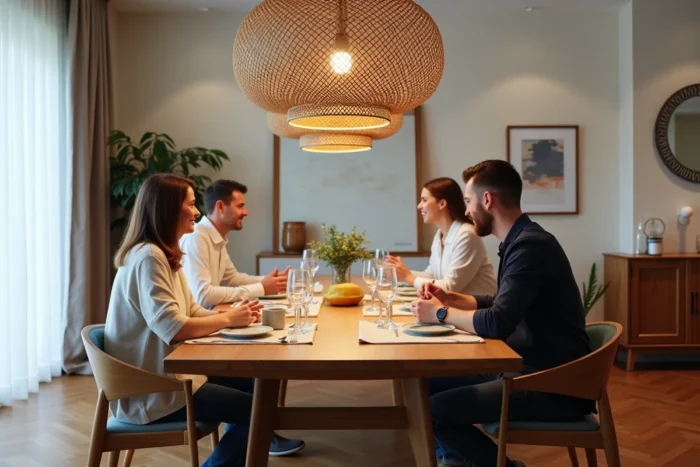
An oversized or organic-shaped light fixture transforms a mundane dining corner into a distinct space. The pendant replaces the decorative function of a painting or mirror while fulfilling a functional need.
Three technical criteria to respect:
- The base of the light fixture should be positioned between 70 and 80 cm above the tabletop for comfortable lighting without visual obstruction
- The diameter of the pendant should be about half the width of the table for a coherent proportion ratio
- A warm light source (around 2700 K) enhances the warm natural tones of the rest of the room
8. Panoramic wallpaper on a single wall to create depth
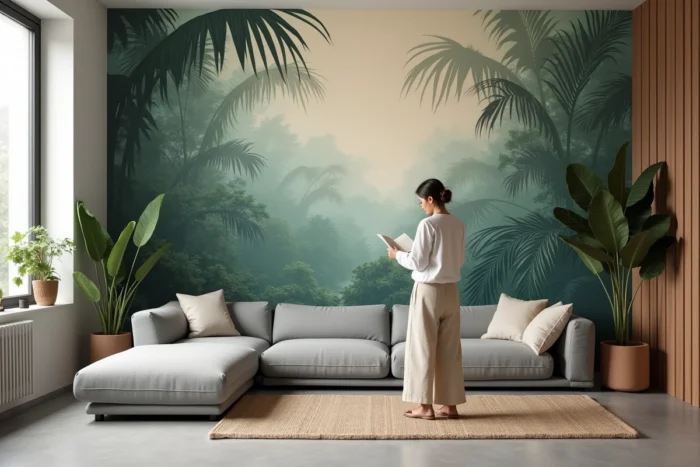
Panoramic wallpaper applied to a single wall produces a depth effect that paint cannot replicate. Large-scale botanical or landscape patterns work particularly well in bedrooms or narrow hallways.
One wall is enough, never two opposite faces. Doubling the panoramic creates visual confusion and nullifies the perspective effect. The chosen wall should be the one visible upon entering the room.
9. Wooden screen to separate without partitioning in an open space
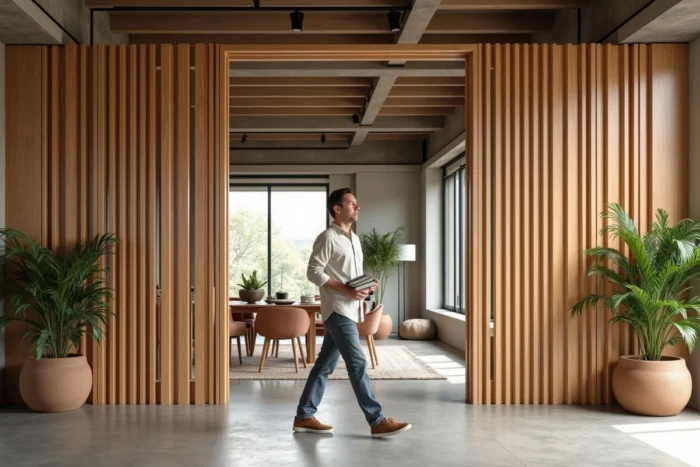
In an open layout, the wooden screen (vertical slats fixed from floor to ceiling) delineates a workspace or entryway without blocking light. The separation remains visually permeable, preserving the feeling of space.
The choice of wood type and spacing between the slats determines the degree of privacy. Closely spaced slats with dark wood (walnut, smoked oak) create a marked filter. Widely spaced slats in light wood (ash, beech) allow most light to pass through.
10. Integrated masonry bench for a custom reading nook
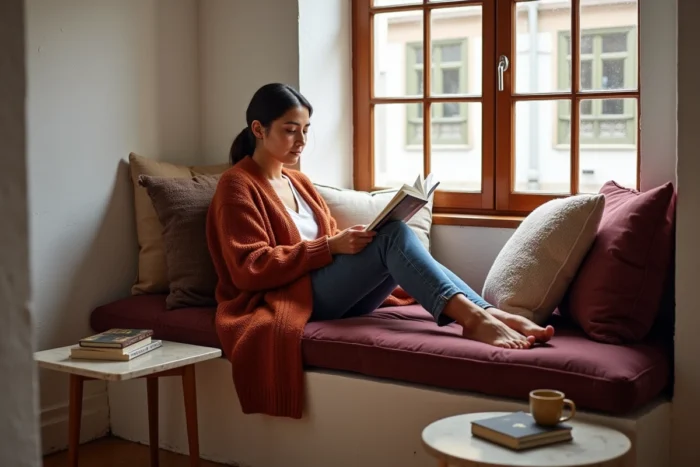
The masonry bench, integrated under a window or in an alcove, combines seating, storage, and architectural element. It does not move, does not go out of style, and adds usable surface without further furnishing.
The masonry seat often extends with side niches or shelves. Plan for a seat depth of at least 50 cm for real comfort. A custom cushion in linen or corduroy completes the whole and anchors the bench in the room’s color palette.
These ten ideas share a common thread: they intervene on the very structure of the space (surfaces, volumes, structuring furniture) rather than on the layer of accessories. A painted ceiling, a graphic floor, or a masonry bench permanently transform an interior, where a change of cushions is forgotten in a few weeks.