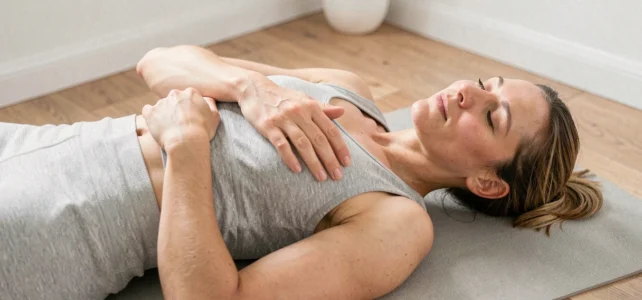
The diaphragm is the main driver of respiration. Yet, most fitness programs prefer superficial abdominal exercises or cardio. Recent publications in respiratory rehabilitation are refocusing the topic: mobilizing this muscle is not just about inflating the belly. The respiratory rhythm, starting posture, and progression of positions are just as important as the movement itself.
Slow respiratory rhythm and prolonged expiration: the underestimated parameter
The most shared tutorials on diaphragm strengthening focus on the mechanics of abdominal movement. Inhale by inflating the belly, exhale by drawing it in. This framing remains incomplete.
Recent sources in respiratory physiology converge on a precise point: the respiratory rhythm matters more than abdominal amplitude alone. A slow practice, around six breaths per minute, with a significantly longer expiration than inspiration, engages the diaphragm more effectively from a neuromuscular standpoint. Prolonged expiration activates the parasympathetic nervous system, which reduces heart rate and promotes overall muscular relaxation of the trunk.
Practicing exercises to strengthen the diaphragm without this dosage framing is akin to working a muscle without controlling the contraction tempo. The movement exists, but the stimulus remains insufficient to produce a measurable adaptation.
Nasal breathing, often mentioned as a detail, also plays a structuring role. It naturally slows the airflow and forces the diaphragm to work against light resistance, increasing the mechanical effort without requiring equipment.

Postural progression of the diaphragm: lying down, sitting, standing, walking
The postural progression in respiratory training directly conditions the results. Recent clinical rehabilitation protocols recommend structuring diaphragmatic work according to four levels of increasing difficulty.
Lying level: the foundation of learning
The supine position with knees bent eliminates the action of gravity on the abdominal viscera. The diaphragm descends more easily during inhalation. This posture allows one to feel the movement of the belly under the hands and to correct thoracic compensations.
This is the only level where the coordination between abdominal inhalation and thoracic relaxation can be learned without parasitic postural effort.
Sitting and standing levels: integrating gravity
In a seated position, the abdominal organs exert downward pressure. The diaphragm must work harder to descend during inhalation. The posture of the spine comes into play: excessive thoracic kyphosis limits the diaphragm’s movement and reduces functional lung capacity.
Standing, the constraint increases further. The diaphragm works simultaneously as a respiratory muscle and as a trunk stabilizer. Some practitioners observe that patients master diaphragmatic breathing well while lying down but completely lose the pattern when standing, confirming the importance of working each level separately.
Walking level: the functional test
Maintaining slow diaphragmatic breathing while walking is the true indicator of mastery. The coordination between the rhythm of steps and the respiratory cycle engages the diaphragm in a dynamic context. This level is only relevant once the previous three have been mastered.
Diaphragm and lumbar stabilization: beyond breathing
The diaphragm is not just a respiratory muscle. It actively participates in stabilizing the lumbar spine through the intra-abdominal pressure it generates with each deep inhalation. Recent protocols integrate diaphragmatic work into the management of lumbar instability, no longer just in respiratory programs.
The anatomical link is direct: the diaphragm attaches to the lumbar vertebrae L2 and L3, shares fibers with the psoas, and maintains a reciprocal tension relationship with the quadratus lumborum. An underutilized or chronically tense diaphragm can contribute to lumbar and pelvic stiffness.
Three concrete elements allow for exploiting this connection:
- Practicing diaphragmatic breathing in a quadrupedal position (on all fours), which forces the diaphragm to work against gravity while stabilizing the trunk without back support
- Combining prolonged expiration with a slight contraction of the transverse abdominal muscle to increase intra-abdominal pressure in a controlled manner
- Integrating respiratory work into core stability exercises, maintaining diaphragmatic breathing during a plank or dead bug, rather than holding the breath
This combined approach transforms the diaphragm into a muscle of postural performance, not just a relaxation tool.

Known limitations of diaphragmatic breathing
Diaphragmatic breathing enjoys a trendy effect that tends to make it a universal solution. The available data nuances this image.
The effect on stress and anxiety exists but remains modest when measured in isolation. The clearest benefits appear when the practice is slow, nasal, and includes prolonged expiration. Rapid and shallow abdominal breathing, even if mechanically correct, does not produce the same results.
Furthermore, diaphragmatic breathing is not suitable for all functional digestive disorders. In some individuals suffering from aerophagia or symptoms related to swallowed air, intense mobilization of the diaphragm may worsen discomfort rather than relieve it.
Lastly, a rarely addressed point: reproducibility. Many practitioners report an excellent sense of mastery during guided sessions but struggle to maintain the breathing pattern in everyday life, under stress or exertion. The postural progression described above aims precisely to bridge this gap between practice in ideal conditions and real-life use.
Strengthening the diaphragm benefits from being approached as progressive training, with calibrated parameters of rhythm, posture, and duration, rather than as a series of gestures to be mechanically reproduced. It is this structuring that distinguishes effective practice from a mere relaxation exercise.