
The lifespan of a mobile home on a camping plot raises many questions, especially when a manager invokes an age limit to request the removal of a leisure mobile residence. The central question concerns the legal basis for this limit and what the owner can actually negotiate or contest.
Plot Contract and Obsolescence Clause: What the Law Provides
Contrary to popular belief, no national text sets a maximum age for a mobile home. The Urban Planning Code defines the leisure mobile residence (decree no. 2007-18 of January 5, 2007) and regulates the authorized locations for installation, but it does not mention any regulatory lifespan.
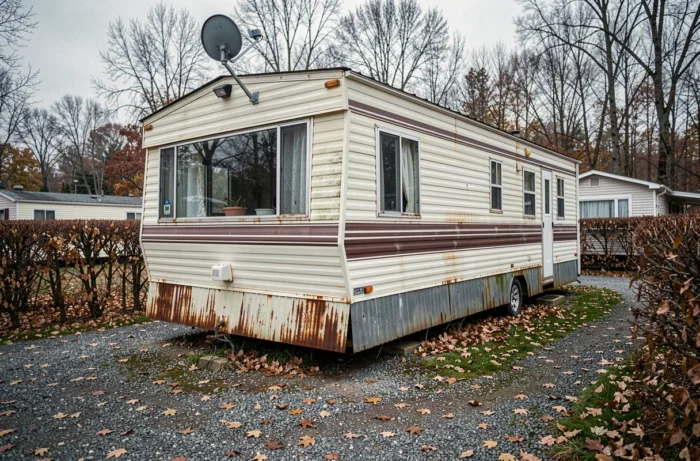
The famous ten-year limit, sometimes extended to fifteen or twenty years, comes exclusively from the internal regulations of the camping site or the lease agreement signed between the mobile home owner and the site manager. It is therefore a contractual clause, not a legal obligation.
The distinction is crucial: an owner who signs a contract containing a withdrawal clause after a certain number of years accepts this condition. If they did not sign it, the manager cannot rely on a legal text to impose the departure of the mobile home. To better understand the 10-year rule for old mobile homes, one must carefully read the clauses of their own contract before taking any further steps.
Comparison of Age Limits by Type of Land
The conditions vary significantly depending on the type of accommodation structure. The table below summarizes the main differences observed between traditional campgrounds, residential leisure parks (PRL), and private lands.
| Type of Land | Common Age Limit | Basis | Negotiation Margin |
|---|---|---|---|
| Traditional Camping (chain or independent) | 10 to 20 years | Internal regulations / contract | Low to medium |
| Residential Leisure Park (PRL) | Variable, often more flexible | Plot lease agreement | Medium |
| Private Land (buildable area) | No age limit | PLU and urban planning authorization | Free, subject to PLU |
In camping, managers generally set a duration related to their commercial strategy: renewing the fleet of mobile homes helps maintain a star rating or brand image. In PRL, the mobile home owner often has more favorable conditions, as the contract pertains to the plot and not the residence itself.
Role of the Local Urban Planning Plan
On private land located in a buildable area, the PLU does not set an age limit. However, in sensitive natural areas or classified sites, local authorities may limit the installation of mobile residences or even request the removal of structures deemed incompatible with landscape protection. It is not the age of the mobile home that is targeted, but its presence on a protected site.
Abusive Clauses and Mobile Home Owner’s Recourse
Not all obsolescence clauses hold the same legal weight. Some contracts require the replacement of the mobile home with a new model purchased exclusively from the camping site, which can constitute a questionable commercial practice.
The points to check in a plot lease agreement are as follows:
- The duration of the contract and the renewal conditions: a renewable annual contract does not guarantee the maintenance of the plot, even if the mobile home is recent.
- The mandatory buyback or withdrawal clause: some campgrounds impose a buyback at a depreciated price, which financially penalizes the owner.
- The obligation to purchase exclusively from the manager for any replacement, a practice that the FFCC (French Federation of Camping and Caravanning) qualifies as restrictive.
- The criteria for assessing obsolescence: condition of the chassis, exterior appearance, compliance of safety equipment.
The absence of objective criteria in the contract weakens the position of the manager who wishes to impose a withdrawal. A well-maintained mobile home, with a sound chassis and compliant equipment, can contest a formal notice based solely on its year of manufacture.
Contesting a Refusal to Renew
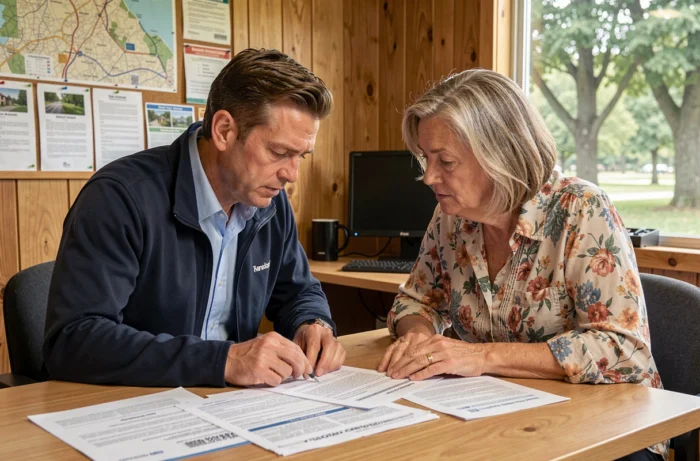
The first step is to thoroughly reread the signed contract. If the obsolescence clause is vague or absent, the manager has no contractual basis to demand departure. In case of dispute, mediation through a consumer association or the DGCCRF can be initiated before any legal proceedings.
Actual Lifespan of a Mobile Home and Evaluation Criteria
A well-maintained mobile home can remain functional and habitable well beyond the limit set by campgrounds. The physical lifespan depends on the quality of manufacturing, exposure to the elements, and especially regular maintenance of the roof, chassis, and ventilation.
Maintenance of the chassis and waterproofing directly conditions the longevity of the structure. A mobile home with a corrosion-protected undercarriage and periodically replaced seals retains its structural integrity for several decades.
Campgrounds assess obsolescence according to internal grids that generally combine the exterior condition (cladding, joinery), interior condition (finishes, sanitary equipment), electrical and gas compliance, and the overall appearance of the plot. These grids are not standardized at the national level, leading to significant disparities from one establishment to another.
Local Environmental Constraints and Old Mobile Homes
An often-overlooked angle in discussions concerns the environmental constraints imposed by local authorities. A camping site located within a classified site perimeter, a Natura 2000 area, or a natural risk prevention plan may be required to reduce its fleet of mobile residences.
In this case, the manager does not rely on the age of the mobile home but on a local regulatory obligation. The owner then has little recourse, except to demonstrate that their mobile home does not contribute to the environmental impact targeted by the measure.
This increasing emphasis on local environmental protections leads some campgrounds to accelerate the renewal of their fleet, using the obsolescence clause as a convenient lever. Checking if the camping site is located in a protected area helps distinguish a real regulatory constraint from a mere commercial policy.
The legal status of the mobile home remains that of a movable property, meaning that the owner retains ownership of their residence even in the event of non-renewal of the plot contract. The manager may refuse to extend the plot, but they cannot confiscate or destroy the mobile home without the owner’s consent.