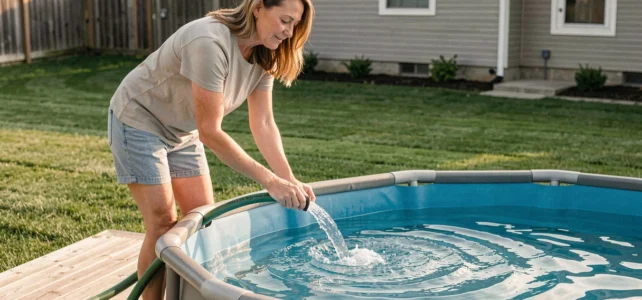
The hose has been running into the pool for an hour, and you’re wondering when to stop. Too low, the pump sucks in air. Too high, the water overflows with the slightest splash. The correct level of an above-ground pool is not just a line drawn on the wall: it depends on the structure of the pool, the flatness of the ground, and even the season.
Flatness of the ground: the factor that the water level does not correct
Before discussing filling, we need to talk about the ground. A difference of a few centimeters on the ground translates into a visible difference in water height from one side of the pool to the other. The pool may appear to be filled correctly from one edge, but it is too low on the skimmer side on the other.
Have you ever noticed an above-ground pool that tilts slightly after a few weeks? The weight of the water accentuates any level defects in the ground. Some recent technical guides specify that a check across the entire diameter of the pool is more reliable than a simple check in the center.
Check the flatness before each season, not just at installation. Frost, rain, and natural settling of the ground change the support from year to year. A bubble level placed on a mason’s rule, crossing the entire surface, is enough to detect a problematic gap. If you want to know when to fill your above-ground pool with Youpi La Maison, this step of checking the ground is the real starting point.
Step-by-step filling: why to raise the water gradually
Turning on the tap and coming back three hours later seems logical. In practice, filling an above-ground pool all at once prevents correcting two common problems: wrinkles in the liner and the tilt of the structure.

Step-by-step filling involves raising the water in successive increments. At each increment, you check that the liner fits the bottom without forming air pockets. You also check that the posts remain vertical.
- First increment: fill to about ten centimeters, then smooth the liner manually towards the walls to eliminate wrinkles
- Second increment: raise to half height, check the verticality of the posts with a level
- Third increment: continue to the skimmer mark, adjust if the water line appears uneven from one side to the other
A defect detected halfway through filling can be easily corrected, while a wrinkle trapped under the weight of a full pool becomes nearly impossible to fix without partial draining.
Ideal water level for above-ground pools: the skimmer mark
The universal marker remains the skimmer. The water should cover between half and two-thirds of the skimmer opening. This is not an aesthetic approximation; it is a mechanical constraint.
If too low, the filtration pump sucks in air. It loses prime, overheats, and wears out prematurely. A pump that runs dry for a few minutes can be enough to damage it. If too high, the skimmer no longer creates the surface effect that captures floating debris. Leaves and insects remain in the pool instead of being sucked in.
In an above-ground pool, the level drops faster than in an inground pool. The surface exposed to wind and sun is proportionally larger compared to the volume. In the middle of summer, the daily drop due to evaporation and splashes can be surprising.
The bucket test to distinguish evaporation from leaks
Why this distinction? Because adding water each week to a leaking pool is like treating a symptom without looking for the cause. The bucket test is a simple diagnostic reflex.
Place a bucket filled with water on the first step or a stable support in the pool. Mark the water level in the bucket and the water level of the pool. Wait 24 hours without swimming or covering.
If both levels drop by the same height, it’s evaporation. If the pool level drops more than that of the bucket, a leak is likely. This test avoids wasting water on unnecessary refills and points towards an inspection of the liner or connections.
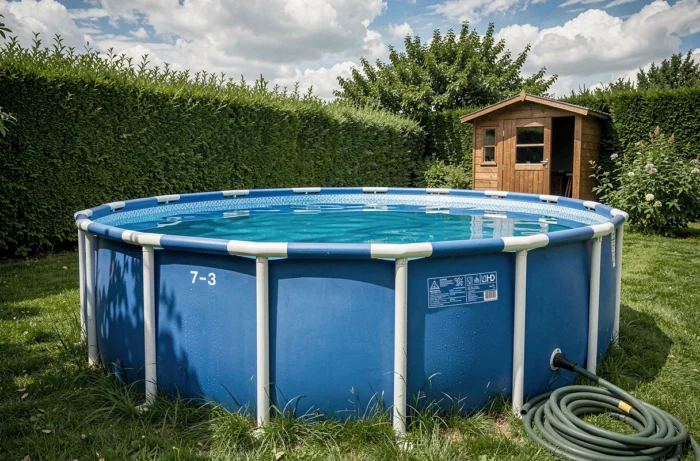
Filling your above-ground pool at the right time of the season
The classic temptation: waiting for the first heat wave to pull out the pool and fill it in a hurry. The problem is that water restriction orders often come at these times.
Filling early in the season, as soon as nighttime temperatures remain positive, has several concrete advantages:
- The pressure on the water resource is lower in spring, reducing the risk of falling under a local restriction
- The water from the mains is cooler, which slows down algae growth during the first days of startup
- You have time to balance the pH, TAC, and water treatment before the first swim, without rushing
Check the prefectural orders in your department before any filling. The alert levels (vigilance, alert, reinforced alert, crisis) determine whether filling is allowed, limited, or prohibited. These orders can change from week to week depending on precipitation.
Also prioritize conserving the water already present rather than a complete renewal. A cover or solar blanket significantly reduces daily evaporation and limits water top-ups throughout the summer.
Maintaining the water level during the season
Once the pool is filled to the correct level, the work is not finished. Checking the water level each week allows you to react before the pump suffers from running dry.
During periods of intense heat, regular water top-ups compensate for natural evaporation. Preferably do this in the morning when evaporation is minimal and the temperature of the mains water is lowest. After a heavy storm, conversely, check that the level hasn’t risen too much: prolonged overflow can destabilize the ground around an above-ground pool and weaken the base of the pool.
The right reflex is to monitor the skimmer. As long as the water covers half of its opening, the filtration works correctly and the pool maintains its balance. A quick glance while passing by, morning or evening, is enough to ensure a season without unpleasant surprises.