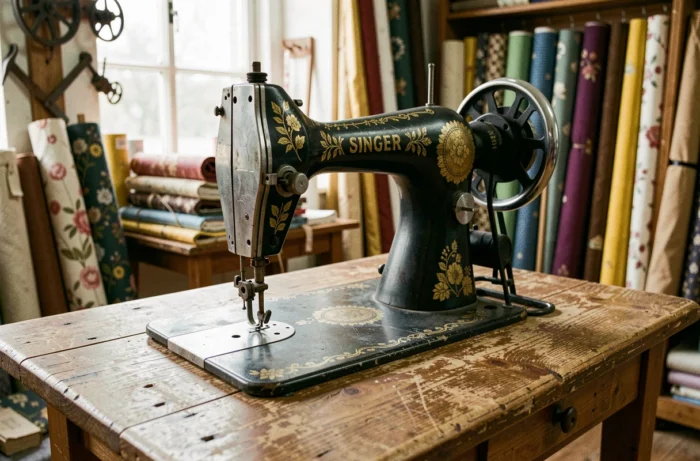
When you find an old Singer sewing machine in an attic or at a flea market, it’s rarely the mechanism that catches your eye first. It’s the gilding on the plate, the floral arabesques, sometimes a stylized sphinx that draws attention. These decorations are not just cosmetic embellishments. They tell a story of a production era, an original factory, and sometimes even the technical class of the sewing machine.
Painted Designs or Decals: How to Date a Decorative Singer
On the ground, the first question one asks when faced with an adorned Singer machine is simple: hand-painted or decal? The answer changes the age range of the machine.
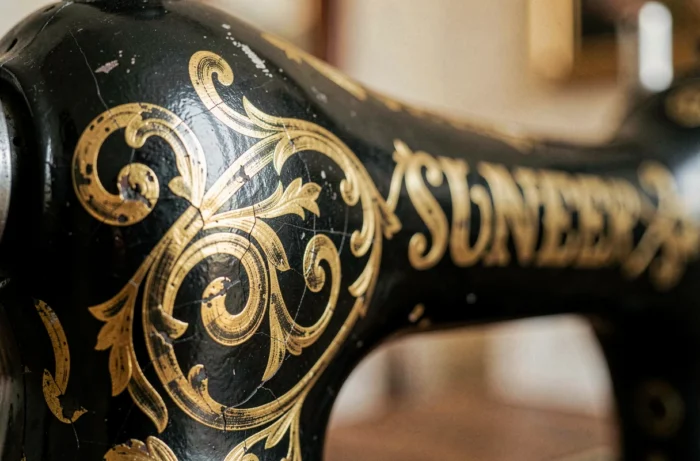
The oldest machines feature hand-painted designs, recognizable by their visible brush strokes under good side lighting. Irregularities in the strokes, slight variations in the thickness of the gilded lines are markers of manual production. Decals, on the other hand, became widespread on later series, with sharp outlines and mechanical uniformity.
This distinction provides a useful clue for dating a machine, but it must be cross-referenced with the model and serial number. A well-preserved decal does not necessarily mean a recent machine, and a chipped painted decoration does not guarantee a piece from the 19th century. You can find everything about the decorative Singer sewing machine by cross-referencing these clues with reference catalogs.
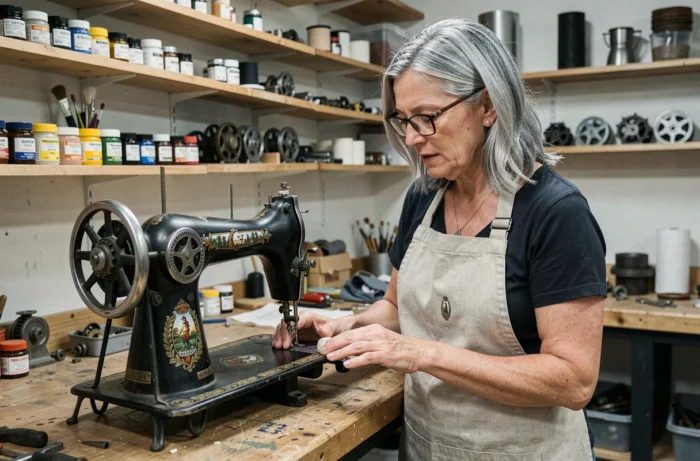
Singer Patterns and Identification: Sphinx, Celtic Swirl, and Other Series Decorations
The decorative patterns of Singer machines are not random. Each decoration corresponds to a model, a period, sometimes a specific factory. It’s a complete identification tool.
The Sphinx decoration (also known as Memphis or Egyptian) is documented on machines from classes 15, 27, and 128. Its use is recorded from the late 19th century until the 1950s. It is recognized by its geometric patterns inspired by Egypt, often gilded on a black background.
Other decorations help refine the geographical origin of production. For machines made at the Singer factory in Saint-Jean-sur-Richelieu, Canada, several specific decorations are documented over distinct periods:
- The Celtic Swirl, with its Celtic interlacing in gold, associated with a well-identified Canadian production
- The Gold Wings, recognizable by its stylized wings on either side of the front plate
- The Hearts and RAF decorations, rarer, corresponding to limited series over time
The intersection between the prefix of the serial number and the type of decoration allows for more than just a general dating. You can identify the factory of origin, which changes the documentary (and sometimes market) value of the machine.
Condition of the Decoration and Value of an Old Singer Sewing Machine
At flea markets and resale sites, Singer machines are often sold as “decorative” without distinction of the quality of the decoration. The price varies significantly depending on the condition of the ornaments and the rarity of the pattern.
A complete and legible decoration significantly increases the appeal of a machine, even if the sewing mechanism is stuck. Conversely, a machine with faded decals or covered in yellowed varnish loses much of its visual interest.
Here are a few points to check when evaluating the condition of a decorative Singer:
- The sharpness of the gilded lines on the edges of the plate: if they are continuous and shiny, the decoration has been well protected
- The absence of amateur repainting, often betrayed by a thick, shiny layer that obscures fine details
- The consistency between the visible decoration and the announced model, as some machines have been reassembled with parts from different series
Opinions vary on this point, but the presence of the original cabinet or table in good condition adds a dimension to the whole. A Singer on its cast iron cabinet with a complete pedal attracts a different audience than those looking solely for the machine head.
Decorative Singer: Between Sewing Object and Collectible Piece in France
In France, old Singer machines hold a special place. They equipped millions of households from the second half of the 19th century, when Singer opened its Paris branch and won a first prize at the Paris Fair in 1855. The brand became the first true multinational in its sector.
Commercial innovation also played a role. The rent-to-own system proposed by Edward Cabot Clark, co-founder of the Singer Manufacturing Company, allowed payments to be spread over several months. This mechanism literally opened the domestic sewing market to households that could not afford to pay for a machine all at once.
Today, these machines are found in two distinct markets. The first is that of collectors who seek specific models, with an identified decoration and a traceable serial number. The second is that of interior decoration, where the Singer machine serves as an accent piece or a statement piece in a vintage interior.
What Distinguishes a Collectible Piece from a Simple Decorative Object
A collector checks the correspondence between the serial number, the model, the decoration, and the original factory. A decor buyer looks at the silhouette, the patina, and the overall condition of the cast iron or wood.
The two approaches coexist, but they do not value the same elements. A complete Sphinx pattern on a class 15 in working condition interests a vintage sewing machine enthusiast. A Singer cast iron base without a machine head, transformed into a table top, finds a buyer among decorators.
The boundary between these two markets remains blurred, and that is precisely what makes decorative Singers so present in listings as well as in showrooms. Their quality of craftsmanship, the robustness of the cast iron, and the finesse of the decorations give them a longevity that few industrial products from the 19th century can claim.