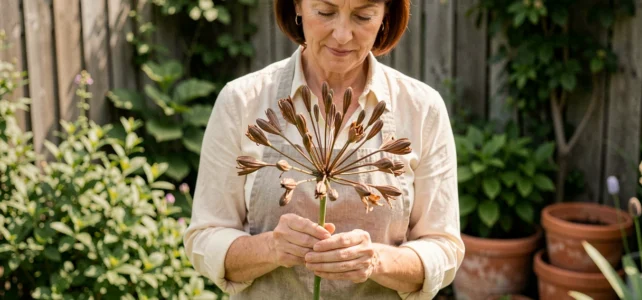
Cutting a faded agapanthus flower stem at the base of the umbel is a common mistake that leaves a bare stem without interest amidst the foliage. The cut should be made as close to the base of the stem as possible, without damaging the leaf crown.
The question of what to do with a faded agapanthus flower goes far beyond the act of pruning: seed collection, ornamental drying, composting, or structuring a winter bed, each option has its specific technical conditions.
Dried agapanthus umbels: architectural material for sustainable bouquets
Floral design studios now incorporate dried agapanthus umbels as permanent structural elements in “muted-natural” compositions. Just like poppy capsules or ornamental grasses, the dry seed head of the agapanthus offers a graphic silhouette that lasts between one and three years without renewal.
To achieve a usable result, we recommend leaving the stem to dry on the plant until the stem turns a uniform light brown. Cutting too early, when the stem is still green, causes sagging during drying and an unflattering grayish color.
The drying process is completed upside down, in a ventilated space and away from direct light, for two to three weeks. No chemical treatment (bleaching, dyeing) is necessary: the natural hue, ranging from golden beige to light brown, perfectly matches the trend of undyed bouquets that currently dominate the dry floral decoration market.
When wondering what to do with a faded agapanthus flower, ornamental drying represents the highest value-added option for minimal effort.
Harvesting agapanthus seeds: technique and varietal limits
Not all agapanthus should be allowed to go to seed. Hybrid varieties (the majority of cultivars sold in garden centers) produce seeds whose offspring will be heterogeneous and rarely true to the parent plant. Only botanical species justify sowing if the goal is to reproduce a specific type.
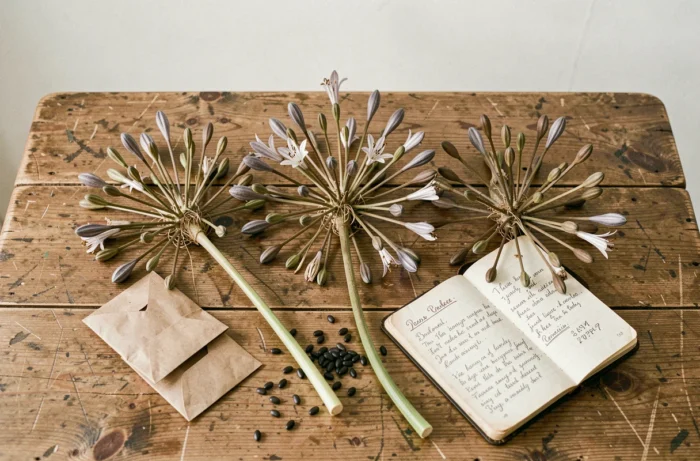
The green capsule that appears after flowering in August contains this potential. We leave the capsules on the stem until they begin to open naturally, a sign that the seeds are mature. Harvesting them before this stage yields non-viable seeds.
- Detach the open capsules over a dry container and shake gently to release the black, fine, flat seeds.
- Store in a paper envelope (not plastic, to avoid condensation) in a cool, dry place until the following spring sowing.
- Sow in a tray under cover, barely covered with fine soil: germination takes several weeks, and the first flowering will only occur three to four years later.
For a gardener looking to quickly multiply their agapanthus, clump division at the end of summer is still much more effective than sowing.
Faded stems left in place: ecological interest and winter structuring
Public maintenance articles consistently recommend cutting faded stems. We nuance this: leaving a few dry umbels on the plant enriches the garden’s biodiversity. The seed heads feed certain songbirds in the fall, and the hollow stems provide winter shelter for beneficial insects.
This choice also has a landscape dimension. In a mixed bed combining grasses, sedums, and agapanthus, the dry silhouettes extend the visual interest of the garden from November to February. The low winter light enhances the graphic quality of the umbels, especially when covered in frost.
The trade-off is real: an agapanthus going to seed diverts some of its energy at the expense of storage in the roots. For a young or weak plant, it is better to cut all the stems right after flowering to encourage reserve formation before frost. For a clump established for several years, leaving two or three stems does not compromise the next flowering.
Composting agapanthus stems: technical precautions
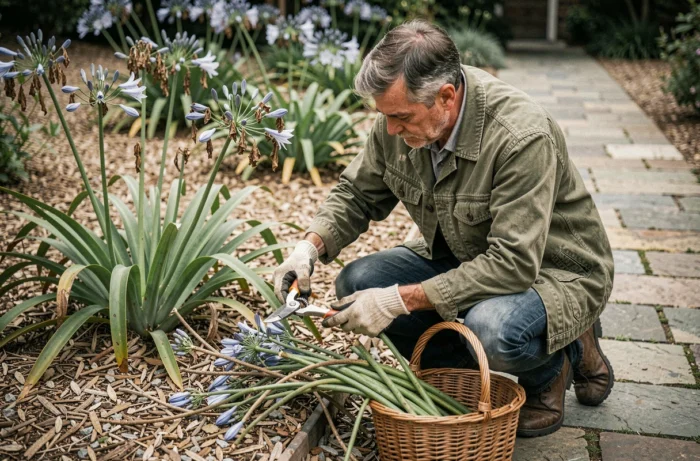
Agapanthus flower stems and leaves compost easily, provided a few rules are followed. The stem, fibrous and thick, decomposes slowly if thrown whole into the bin.
We cut it into segments of five to ten centimeters with pruning shears before incorporating it. This action speeds up decomposition and prevents fibrous clumps that block compost aeration. The leaves, being softer, can be added without prior cutting.
- Mix agapanthus residues with nitrogen-rich materials (grass clippings, peels) to balance the carbon/nitrogen ratio of the pile.
- Do not compost stems bearing mature seeds if the compost does not reach a sufficient temperature to neutralize germination.
- If in doubt about the maturity of the seeds, let the stems dry separately before grinding and incorporating them.
Agapanthus do not present problematic toxicity for domestic compost, unlike some plants with irritating sap that require handling precautions.
Agapanthus and resilient gardens: a perennial for climate change
Adaptation to dry summers
Agapanthus is among the perennials recommended for resilient gardens facing climate change. Its fleshy root system tolerates prolonged drought periods once the plant is well established. This robustness explains its growing success in Mediterranean landscapes and urban gardens subjected to heat islands.
Differentiated management according to context
The management of faded flowers directly depends on the garden project. A strict ornamental bed calls for immediate pruning after flowering. A naturalistic garden or an ecological space benefits from retaining some of the dry stems. A gardener interested in interior decoration harvests their most beautiful umbels before they degrade in the rain.
This differentiated approach, which clearly distinguishes the living plant in the ground from the harvested dry plant material, allows for maximizing each flowering cycle without compromising the vigor of the mother plant for the following seasons.