
Form Cerfa 15646-01 governs the authorisation to leave the country (AST) for any minor leaving France without a holder of parental responsibility. The form can be completed online at service-public.gouv.fr, does not require a visit to the town hall and is valid for a maximum of one year from the date of signature.
Two issues regularly cause problems at border checks: a difference in surname between the child and the signing parent, and stopovers in a third country. These are the potential sticking points rarely covered in standard guides and deserve closer attention.
Different surnames for parent and child: what Form Cerfa 15646-01 provides
Form Cerfa 15646-01 has no section specifically for establishing parentage. It identifies the minor (section 1) and the signing parent (section 2) separately. When they have different surnames, nothing in the document automatically links them.
There is no legal requirement to present the family record book at the border. Under the law, the AST accompanied by a copy of the signatory’s identity document is sufficient. In practice, an officer may ask for additional proof to verify the family relationship.
Including a photocopy of the family record book or birth certificate in the travel documents can help prevent delays caused by a difference in surnames. This precaution is particularly useful for blended families or children who have the surname of only one parent. Every step of the form, section by section, is explained in E-Nomad’s exclusive guide, which also covers useful supporting documents.

Overseas stopovers and the AST: the trap when travelling to an overseas territory
The AST requirement applies as soon as a minor crosses a French border without a parent. The final destination is not the only factor: the entire travel itinerary determines whether the form is required.
A flight to an overseas department with a stopover in another country (transit through an international airport outside French territory) means the minor is leaving the country. The AST is therefore required, even if the final destination is still France.
For a direct journey between mainland France and an overseas territory with no stopover abroad, the AST is not required because the child does not leave national territory. The table below summarises the most common cases.
| Travel situation | AST required | Recommended additional document |
|---|---|---|
| Direct flight from mainland France to Réunion | No | Minor’s identity document |
| Flight from mainland France to Réunion with a stopover outside France | Yes | AST + copy of signatory’s identity document |
| School trip within the EU | Yes | AST + copy of signatory’s identity document |
| Stay with a relative abroad | Yes | AST + copy of signatory’s identity document + family record book if surnames differ |
| Travel with one parent | No | Identity documents for the minor and accompanying parent |
Validity and duration of the authorisation to leave the country
Section 3 of Form Cerfa 15646-01 asks the signing parent to set an expiry date. The duration is flexible, up to a maximum of one year from the date of signature. The parent can therefore tailor the authorisation to a single trip lasting a few days or cover a full year.
A short-term AST reduces the risk of unwanted use if the document is lost or family circumstances change. Conversely, a longer validity period avoids having to renew the form for every trip when the child travels regularly (sports competitions, recurring language stays).
The choice depends on the family’s circumstances. In the event of separation or disagreement between parents, a shorter validity period offers greater control. The form can be renewed as often as necessary.
Objection and ban on leaving the country: the limits of the AST
A correctly completed AST does not override an objection to leaving the country (OST) or a ban on leaving the country (IST). These are separate procedures and take precedence over parental authorisation.
- A parent can apply to the family court for an objection to leaving the country (OST). It prevents a passport from being issued to the minor and blocks their departure even if an AST is in place.
- A ban on leaving the country (IST) is an administrative or judicial measure that applies in specific circumstances (risk of parental abduction, criminal proceedings). Lifting it requires a separate legal process.
- A minor subject to an OST or IST will be turned away at the border, even with a valid, fully completed Cerfa 15646-01.
Who signs the AST when parents are separated?
The signature of just one holder of parental responsibility is sufficient. The signing parent does not need the other parent’s written consent to complete Form Cerfa 15646-01, unless a court order restricts the exercise of parental responsibility.
This rule can sometimes cause tension in contentious separations. A parent who objects to the trip can apply to the court for an OST; they do not have a veto over the form itself.
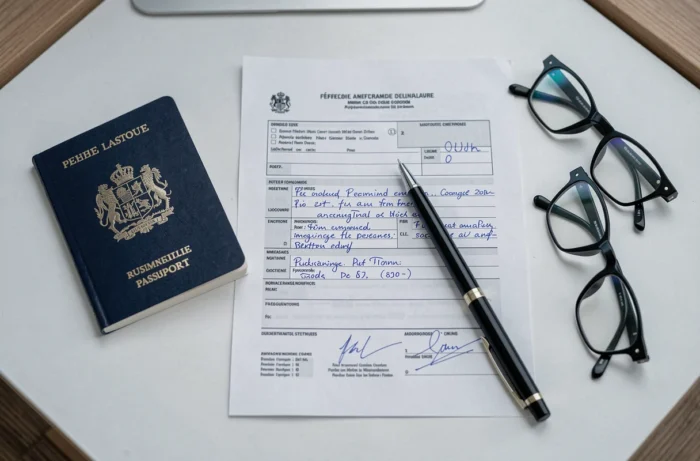
Documents to include with Form Cerfa 15646-01
The travel documents for an unaccompanied minor must include three items:
- Form Cerfa 15646-01, signed by a holder of parental responsibility, with the expiry date completed.
- A photocopy of the signing parent’s identity document. The accepted document depends on the signatory’s nationality: a national identity card or passport for a French national, or a residence permit or foreign passport in other cases.
- The minor’s valid identity document (identity card for travel within Europe, passport for destinations outside the EU).
The family record book, birth certificate or any other document establishing parentage is optional under the regulations. Including one in the travel documents is a useful precaution when the minor and signatory have different surnames.
Form Cerfa 15646-01 covers most trips by unaccompanied minors, but its effectiveness depends on consistency between the form, the supporting documents and the actual travel itinerary. Parents who plan ahead for differences in surnames or international transit can significantly reduce the risk of being turned away at the border.