
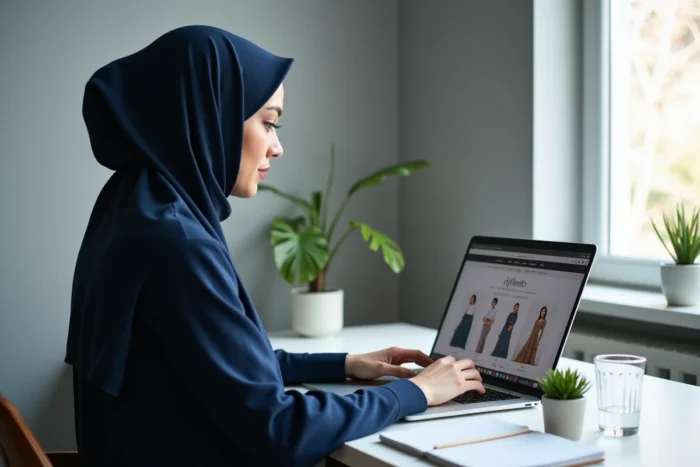
The djilbeb is increasingly being purchased online, driven by an offer that has significantly expanded in recent years. Between specialized boutiques, general marketplace platforms, and independent sellers on social media, the options are plentiful. This diversity raises a concrete question: how to distinguish a reliable purchase from a bad experience, without being able to touch the fabric or try on the garment before ordering?
Technical fabrics and comfort of the djilbeb: what the product sheet should mention
Buying a djilbeb online without information about the fabric is like ordering blindly. Feedback from customers varies on this point: some receive a thick garment in the middle of summer, while others discover a transparent fabric upon receipt. The product sheet serves as the first filter for selection.
The current trend leans towards breathable and lightweight materials suitable for high temperatures. Serious brands specify the exact composition of the fabric and add mentions like “breathable,” “lightweight fabric,” or “integrated lining.” This information is not just marketing: it addresses a real need, especially for women who wear the djilbeb daily or during travels like umrah or hajj.
Among common fabrics, Medina silk remains popular for its lightness. Microfiber offers a fluid drape. Nidha, which is more opaque, is suitable for women seeking maximum coverage without additional lining. Each material requires different care, offers different comfort depending on the season, and has a varying visual effect. A boutique that does not detail these characteristics on its product sheets warrants caution.
Several customers now have the reflex to shop for djilbeb on Boulevard Mode to compare models and access detailed descriptions before placing an order.
Ordering via private message on Instagram and TikTok: precautions to take
Shopping for djilbeb no longer relies solely on traditional e-commerce sites. On TikTok and Instagram, many small boutiques offer direct ordering via private message, with payment through bank transfer, Lydia, or PayPal. This short circuit appeals due to the proximity to the seller and often lower prices.
The problem lies in the lack of structure. No displayed general sales conditions, no standardized return policy, and not always a visible SIRET number. In case of a dispute, the customer finds herself without formal recourse.
Before ordering through a social network, a few checks are essential:
- Read the comments under recent posts to spot feedback from buyers (both positive and negative)
- Ensure the seller posts regularly and shows products in real conditions, not just supplier photos
- Explicitly ask for the return conditions and delivery times before paying, and keep a screenshot of the response
- Prefer a payment method that offers buyer protection (such as PayPal Goods and Services) rather than a bank transfer without a trace
This sales channel should not be dismissed. It allows for the discovery of djilbeb models, khimar, or modest outfits that are hard to find elsewhere. The focus should be on the seller’s transparency, not the channel itself.
Size and cut of the djilbeb online: why guides are not always sufficient
The djilbeb is a loose-fitting garment by definition, which might suggest that the size issue is less critical than for a fitted garment. In practice, the total length and width of the sleeves vary significantly from one brand to another.
A djilbeb that is too short does not fulfill its coverage function. A djilbeb that is too long hinders walking and quickly gets damaged on the ground. Size guides provided by online boutiques generally rely on stature but do not always consider the specific cut of the model (butterfly, straight, flared).
The most reliable reflex remains to look for photos worn by customers, not just catalog visuals. Some boutiques encourage their buyers to post photos with the received product. These visual feedbacks often hold more value than a size chart.

One-piece djilbeb or two-piece set
The choice between a one-piece djilbeb and a two-piece set (top plus skirt) depends on the use. The two-piece set offers more flexibility for prayer and movement, as the top can be adjusted separately. The one-piece, on the other hand, simplifies daily dressing: you slip it on and the hijab is already integrated.
For women who travel, especially for umrah or hajj, the two-piece set often proves more practical to wash and dry quickly. This detail, rarely mentioned on product sheets, makes a concrete difference.
Return policy and customer service: the true marker of reliability
The material, size, color: everything can disappoint upon receipt. What distinguishes a reliable online boutique from another is its clearly displayed and effectively applied return policy.
The points to check before any order of modest clothing are simple but often overlooked:
- The return period (some boutiques allow only seven days, while others extend up to a month)
- The handling of return shipping costs (at the customer’s expense or the boutique’s)
- The refund or store credit: some brands only offer an exchange or a gift voucher
A boutique that hides its return conditions or makes them deliberately difficult to find sends a clear signal. Conversely, a responsive customer service via email or messaging reassures as much as the quality of the product.
Online shopping for djilbeb has become structured, but each order remains an act of trust. Checking the fabric, size, return conditions, and the seller’s reputation before finalizing the cart transforms this trust into an informed decision.