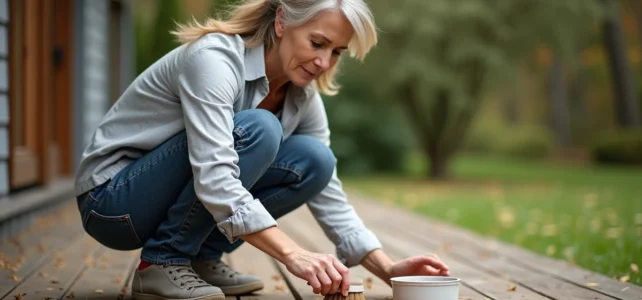
Pine resin is a viscous organic substance that polymerizes upon contact with air and heat. Once hardened on a terrace, it forms an adhesive film that neither a broom nor a standard water jet can dislodge. The choice of removal method depends on the material of the terrace (wood, stone, porcelain stoneware) and the age of the stain.
Fresh resin or hardened resin: two distinct problems on a terrace
A drop of resin that has fallen a few hours ago remains soft. It can be removed mechanically with a paint scraper held almost flat, without applying pressure. The technique matters: tilting the blade at too steep an angle scratches the surface, especially on soft wood like pine.
When the resin has dried for several days in the sun, it hardens and adheres to the substrate by capillarity. On a porous slab (reconstituted stone, raw concrete), the sap penetrates into the micro-cavities of the material. Simple scraping is no longer sufficient; the resin must be dissolved before removal.
Several methods for removing pine resin from a terrace are based on this principle: soften first, scrub next, rinse with clear water to eliminate solvent residues.
Effective solvents and household products against pine resin
Pine resin is soluble in several types of solvents. The choice depends on the substrate and the level of risk acceptable for the finish of the terrace.
Denatured alcohol and acetone
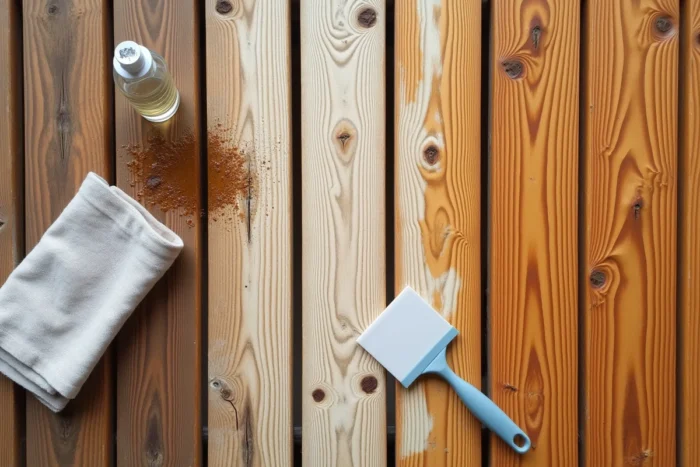
Denatured alcohol dissolves the resin without attacking most stones. It is applied pure on a cloth, dabbed on the stain, and left to act for a few minutes. The resin softens, then detaches with a scraper or brush.
Acetone works on the same principle, with superior effectiveness on very old resins. On porous slabs, acetone penetrates quickly, which speeds up the dissolution. However, on treated or oiled wood, acetone risks dissolving the finish layer. A test on a less visible area remains the basic precaution.
Vegetable oil and oil soap
Vegetable oil (sunflower, olive) acts differently: it does not dissolve the resin but breaks its adhesion to the substrate. A stream of oil is poured onto the stain, left to soak for about ten minutes, then scrubbed with a stiff brush. Vegetable oil is suitable for raw wood terraces because it does not discolor the boards.
Undiluted oil soap, applied directly to the area and left in contact for about twenty minutes, yields comparable results. It has the advantage of rinsing easily with water, without leaving a greasy film.
White vinegar and hot water
Heated white vinegar partially softens the resin. Its effectiveness remains limited on thick or old stains, but it serves as a complement after an initial scraping. Vinegar poses no risk to mineral surfaces (stone, concrete, porcelain stoneware).
Pressure washer on resinous wood terrace: why to be cautious
The reflex to use a pressure washer seems logical against a stubborn stain. On a terrace made of pine or spruce, this reflex poses a real problem.
The high-pressure jet raises the wood fibers and permanently damages the decking boards made of resinous wood. Professional maintenance guides recommend avoiding high-pressure Kärcher on this type of substrate. The wood loses its flatness, becomes rough, and retains even more dirt afterward.
If a pressure washer is used nonetheless, three precautions can reduce damage:
- Set the pressure to minimum and use a wide nozzle, not a concentrated jet
- Hold the lance at a sufficient distance from the surface and move it along the grain, never across
- Pass quickly without insisting on the same area, to avoid digging into the fibers
On a stone or porcelain stoneware terrace, the pressure washer does not pose the same risk. The pressure can be increased, and a pass after applying a degreaser yields good results.
Treated or oiled wood terrace: adapting cleaning to the finish
Recent terraces made of treated pine or thermally modified wood have thinner but more technical finish layers than older autoclave treatments. These modern finishes limit resin exudation but require gentler cleaning methods.
Petroleum solvents (white spirit, turpentine) and acetone risk dissolving or dulling these protective films. Specific degreasing products for wood terraces, formulated with fewer aggressive solvents, allow for treating resin stains without compromising wood protection.
A compatible brightener applied after resin removal restores the uniform appearance of the boards if the solvent has slightly altered the local shade.
Flour and Sommières clay: absorb before scrubbing
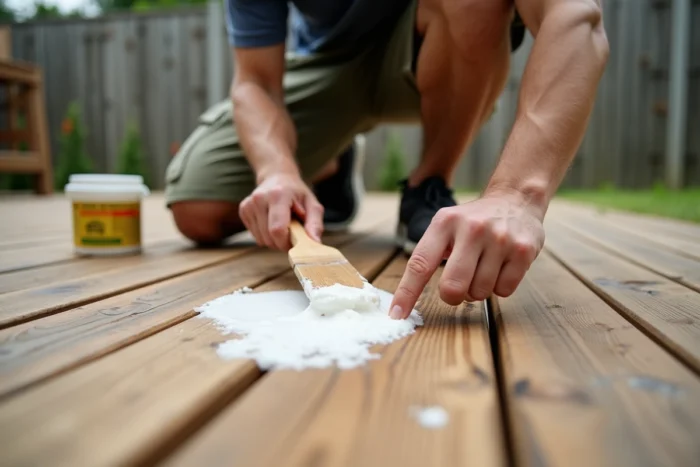
On still sticky resin, generously sprinkling flour or Sommières clay on the stain helps absorb the liquid fraction. The powder clumps the resin and facilitates mechanical scraping. This method works as a pre-treatment before applying a solvent.
Sommières clay is particularly suitable for porous slabs: it penetrates into the micro-cavities, captures the resin deeply, and is removed by brushing. Letting the powder act for several hours significantly improves the result.
Whatever method is chosen, the final rinse with clear water remains a step not to be neglected. Residues of solvent or soap left on the terrace attract dust and create gray marks as they dry, which replaces one problem with another.