
Rennes has concentrated a dense digital ecosystem for several years, supported by engineering schools, incubators, and events dedicated to pedagogical innovation. Within this local fabric, two projects stand out: faljam and ozecollege. Their uniqueness lies less in the technology used than in their grounding in a logic of digital commons and sovereignty, while proprietary platforms remain widely used in the educational sector.
Educational digital commons: what the choice of free software means in Rennes
The rectorate of the Rennes academy has a clear orientation in favor of free software and digital commons, presented as a state ambition. This strategy is not merely a technical choice. It commits institutions to reducing their dependence on private publishers, with direct consequences for student data management, the portability of educational content, and control over licensing costs.
Projects like faljam and ozecollege fit into this framework. Their development relies on open software components, allowing teachers to adapt the tools to their practices rather than the other way around. As documented by faljam and ozecollege on Rennes 17h20, these initiatives illustrate a local shift that goes beyond mere digitalization of the classroom.
However, the question of digital sovereignty in education remains a work in progress. Transitioning to free tools takes time when habits are entrenched in Google or Microsoft environments. Teacher training does not always keep pace with technical deployments.
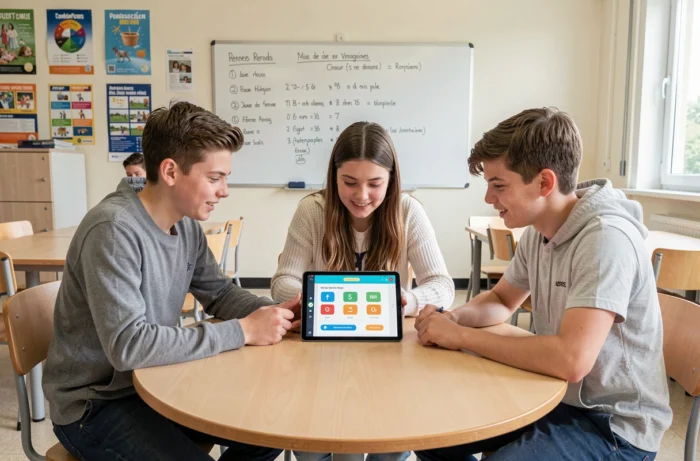
Faljam and ozecollege: pedagogical tools or infrastructure projects
The distinction is worth making. A digital pedagogical tool is judged by its use in the classroom: does it facilitate understanding, free up time for individual support, reduce students’ cognitive load? An infrastructure project, on the other hand, concerns the technical architecture, data hosting, and interoperability with other services.
Faljam and ozecollege sit at the intersection of these two dimensions. They offer features directly usable by teachers while relying on an open architecture. This dual nature sometimes complicates their readability for teaching teams, who primarily seek immediately operational solutions.
What distinguishes them from dominant platforms
Several characteristics separate these projects from traditional commercial solutions:
- The absence of behavioral data collection for advertising or profiling purposes, a sensitive point in the school context where minors are the majority
- The ability for each institution to modify, host locally, or redistribute the source code, ensuring service continuity independent of a publisher’s financial health
- Alignment with the recommendations of the Rennes rectorate on digital commons, facilitating integration into existing academic policies
These structural advantages do not erase a recurring limitation: free interfaces often lag behind commercial products in terms of ergonomics, which hinders spontaneous adoption by less tech-savvy teachers.
Digital sobriety and quality of use: the Rennes debate goes beyond the question of tablets
A Rennes middle school recently chose to return to paper textbooks for its sixth and fifth-grade students, noting better concentration and greater work autonomy. This case has been widely publicized, but it masks a broader debate that is taking shape in the metropolis.
The National Meetings on Digital Communication, hosted at the Rennes Métropole Hotel, now address digital sobriety in public organizations, including educational institutions. The question is no longer just whether to equip classrooms with tablets, but how to design digital environments that do not generate attention overload or technical dependence.
Faljam and ozecollege position themselves in this middle ground. They advocate neither full digitization nor a return to paper. Their approach is to offer tools tailored for specific uses, without seeking to replace the entire educational chain with a screen.
Rennes digital ecosystem: the stakeholders behind these projects
The establishment of specialized training in the metropolis creates a favorable environment. The ECE campus in Rennes has been offering programs focused on artificial intelligence, cybersecurity, data, and networks since 2023. The Learning Show, a national event dedicated to the learning of the future, regularly returns to the city.
These events and training programs feed a pool of skills directly mobilizable by projects like faljam and ozecollege. Final-year students sometimes contribute to the development or testing of these tools as part of academic projects, creating a short circuit between training and deployment.
The limits of a still fragmented ecosystem
The absence of a centralized aggregator for Rennes EdTech initiatives remains a barrier. Projects develop in silos (academy, metropolis, engineering schools, incubators), without always sharing their feedback.
- Local incubators support EdTech startups, but the connection with projects led by the academy remains informal
- Teachers testing faljam or ozecollege do not have a structured channel to relay their observations to developers
- Public funding and calls for educational digital projects circulate among several channels without visible coordination
Coordination between public and private actors is essential for the sustainability of these tools. Without it, there is a risk that these initiatives will remain confidential despite their technical relevance.
The future of faljam and ozecollege will depend less on their intrinsic qualities than on the ability of the Rennes ecosystem to structure systematic user feedback. A permanent feedback channel between designers and teacher users would allow these tools to be adjusted to the real pace of classrooms.