
Day use is not just about renting a room for the day. This hotel booking format, set within specific time slots, meets needs that neither home, coworking spaces, nor cafes adequately cover. Understanding the concrete reasons behind this choice requires moving beyond the simplistic image of resting between two trains.
Time Slots and Day Use Taxation: What the Format Really Imposes
The flexible timing of day use is often presented as its main advantage. The operational reality is more structured. According to Loisirs Verts, the usage window typically falls between 10 AM-11 AM for arrival and 5 PM-6 PM for departure. This framework is not arbitrary: it corresponds to the gap between the check-out of overnight stays and the preparation of rooms for the evening.
This detail changes the perception of the product. Day use does not offer total time freedom, but rather a block of several hours structured around hotel operations. For the user, this means that they need to plan their usage accordingly, especially if the purpose is professional.
On the tax side, Simply Spa specifies that day use is not subject to the tourist tax, which is related to overnight stays. This distinction has a direct consequence on the displayed price: for comparable services, the day use rate includes fewer taxes than a standard overnight stay. However, the establishment must maintain strict accounting traceability when combining day use and overnight stays in the same inventory.
Several user profiles benefit from this configuration, and it is useful to ask why choose a day use hotel when other options seem more obvious at first glance.
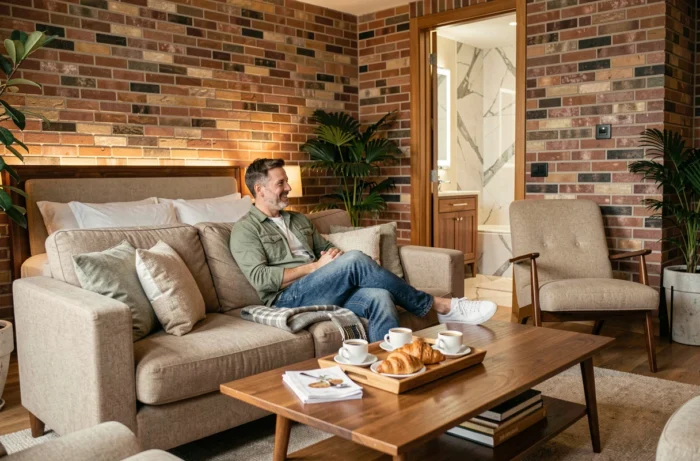
Professional Day Use vs. Coworking: Comparing Uses
The choice between a coworking space and a hotel room during the day depends on criteria that are rarely compared side by side. Here is a framework based on the documented characteristics of each option.
| Criterion | Coworking | Day Use Hotel |
|---|---|---|
| Soundproofing | Variable, often shared | Closed room, complete soundproofing |
| Visual Privacy | Low (open space) | Total |
| Wi-Fi Connection | Shared among members | Dedicated to the room |
| Resting Possibility | None (no bed) | Bed, bathroom, quiet |
| Tourist Tax | Not applicable | Not applicable to day use |
| Typical Slot | Flexible, often half-day | About 10 AM-6 PM |
The main difference lies in privacy and the ability to combine work and rest. A business traveler who needs to handle sensitive files between meetings cannot open a corporate VPN on a shared open space network with the same peace of mind as in a closed room.
Coworking remains relevant for collaborative work or long days. However, for a block of a few hours requiring calm, stable connection, and discretion, day use in a hotel meets a need that coworking does not cover.
The Case of the Transit Traveler
Travelers who drive overnight and arrive in the city in the morning constitute a regular segment of day use. Their need is neither tourist nor professional in the traditional sense: they seek a place to sleep for a few hours, shower, and leave.
No other offer on the market combines a bed, bathroom, and daytime availability in a hotel setting. Airport lounges come close, but they remain limited to air transit areas.
Day Use and Underutilization of Rooms: A Product Born from Hotel Constraints
Coach Omnium emphasizes that day use has become a fully-fledged hotel product, designed as a response to the underutilization of rooms between two overnight stays. This economic origin explains why the format has been structured and professionalized in recent years.
For hoteliers, an empty room between 10 AM and 5 PM represents lost revenue. Day use allows monetizing this time slot without affecting nighttime occupancy. For the client, this translates into rates often lower than a full night, with access to the same services (spa, room service, Wi-Fi).
- The historical day use is still associated with discreet meetings, with establishments on the outskirts of major cities regularly hosting couples during the week, often without luggage and with cash payment.
- Functional day use covers professional uses and breaks on long journeys, with a clientele primarily seeking an isolated and equipped space.
- Experiential day use offers access to hotel services (pool, spa, dining) without an overnight stay, targeting a local clientele seeking relaxation.
This segmentation, documented by Coach Omnium, shows that day use covers at least three distinct markets with very different expectations. A common mistake is to reduce the product to just one of these segments.

Regulation of Short-Term Rentals: A Context that Strengthens Hotel Day Use
The Le Meur law, which recently came into effect, tightens constraints on short-term furnished tourist rentals, particularly in Paris. Several cities have reduced the number of days allowed for renting primary residences, and the reporting obligations have increased.
This tightening does not directly target hotel day use, but it alters the balance for hosts. Individuals who rented their homes for a few hours during the day via platforms now face heavier administrative constraints. Hotels, already compliant with regulations, capture part of this demand by default.
For the end client, booking a day use in a hotel guarantees a clear legal framework, with no risk of cancellation due to an administrative check or a change in local regulations. This legal security, rarely mentioned in comparisons, weighs in the decision of some regular users.
Hotel day use thus finds itself at the crossroads of an operational logic (monetizing empty rooms), fragmented demand (work, rest, discretion, leisure), and a regulatory framework that favors professional players. The most telling data remains that of the time slots: between 10 AM and 6 PM, a hotel room can successively serve a transit traveler, a professional in confidential remote work, and a couple seeking a change of scenery. Three markets, one product, one time constraint.