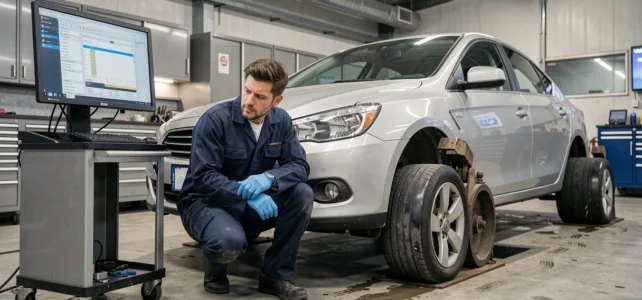
The power test is still associated, in the minds of many motorists, with engine tuning and reprogramming sessions. The reality is more nuanced: this measuring tool is also used for diagnostics, checking a used vehicle, or ensuring regulatory compliance. The cost varies depending on the type of test bench, the service requested, and the chosen provider.
Power Test and Technical Inspection: A Little-Known Regulatory Link
Online content focuses on measuring power after reprogramming. One aspect remains largely overlooked: the power test can serve as a means to secure the legality of engine tuning in relation to homologation.
Any significant modification to the engine (turbo, intercooler, exhaust system) must theoretically be validated by a single vehicle approval (RTI) from the DREAL or DRIEAT, a procedure that includes a test bench run. Without this validation, the vehicle may be declared non-compliant during a technical inspection, especially if the actual power significantly diverges from the declared administrative power or if visible elements do not match the original homologation.
This point becomes increasingly important with the tightening of anti-pollution controls. The particle counting threshold PN has been set at 250,000 particles/cm³ for vehicles equipped with a particulate filter. A removed or damaged particulate filter due to poorly managed reprogramming results in a failed inspection. The power test, coupled with a gas analyzer, allows for verification that the performance gains do not compromise anti-pollution compliance.
Before asking how much the service costs, it is essential to clarify what is expected from the power test. A simple power measurement and a complete diagnostic with engine parameter readings do not fall under the same logic or pricing. To better understand the cost of a car power test, it is necessary to distinguish between these different services.
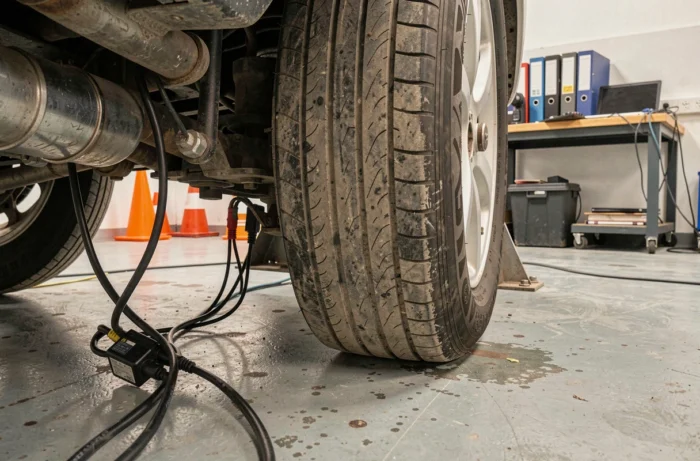
Cost of a Power Test: What Influences the Bill
The price of a power test depends on several concrete factors. Not all test benches measure the same thing, and not all providers offer the same level of detail.
Type of Bench and Engine Type
A two-wheel drive roller bench covers the majority of passenger vehicles. All-wheel drive vehicles require a synchronized four-wheel drive bench, which is rarer and more expensive to operate. The price difference between the two can be significant.
The engine type also plays a role: a naturally aspirated engine with low power puts less strain on the bench than a turbocharged engine developing several hundred horsepower. Some tuners adjust their pricing grid based on the expected power.
Content of the Service
A raw measurement (one or two runs on the rollers with power and torque readings at the wheels) constitutes the basic service. More comprehensive services include:
- A recording of the power and torque curves across the entire RPM range, with digital export
- A before/after measurement after reprogramming (two test sessions, sometimes billed separately)
- A recording of additional parameters: intake temperature, boost pressure, air/fuel mixture richness, exhaust gas temperature
- A diagnosis interpreted by a technician, identifying anomalies (worn turbo, clogged injectors, obstructed intake)
A simple power reading costs significantly less than a complete diagnostic with multiple engine parameter measurements. Field feedback varies on this point: some tuners include everything in a single package, while others charge for each service a la carte.
When a Power Test is Truly Justified
The power test does not have a systematic utility. A few situations make the expense relevant.
Verifying an Engine Reprogramming
After a reprogramming (stage 1 or bioethanol E85 conversion), the power test remains the only objective means to confirm the claimed gains. A serious tuner generally offers a before/after reading. If this is not the case, an independent power test protects against fictitious services.
Diagnosing an Unexplained Loss of Power
A vehicle that seems less powerful without an apparent fault code may reveal a measurable drop on the test bench. Common causes include: worn turbo, partially clogged injectors, leaks in the boost circuit. The bench quantifies a feeling, which guides the mechanical diagnosis.
Validating the Condition of a Used Sports Vehicle
A power test before purchasing a used sports car allows for verification that the measured power corresponds to the model specifications. A significant discrepancy may indicate an undeclared modification, a worn engine, or hidden alterations.

Car Power Test: Parameters That No One Looks At
The majority of motorists focus on the power figure at the wheels. The most useful data can be found elsewhere on the results sheet.
The torque curve provides information about the engine’s flexibility at low RPM and the smoothness of the power increase. A torque that drops sharply at a given RPM may indicate a problem with boost or engine mapping.
Exhaust gas temperature (EGT) and boost pressure provide reliability indicators. An abnormally high EGT under maximum load suggests a mixture that is too lean, a situation that can damage valves and the turbo in the medium term. These parameters help detect a mechanical risk before it becomes a failure.
The air/fuel mixture richness (AFR) checks that the ECU is correctly dosing the injection. After an E85 conversion, this parameter becomes particularly critical: ethanol requires a higher injection flow than gasoline, and poorly calibrated mapping can lead to excessive consumption or overly lean operation.
A power test that only measures maximum power misses the essential. The additional cost of a multi-parameter reading is justified when the vehicle has undergone a modification or exhibits abnormal behavior. Power is just a final result: it is the intermediate parameters that tell the true state of the engine.